
How to Build Your 2027 Marketing Plan in 5 Steps
It’s Q4, and at most businesses, someone has already said, “We really need to plan for next year.” Then the calendar fills up and nobody blocks off the time. Some teams skip planning and figure it out in January. Others spend weeks on a polished deck that gets opened once and forgotten by February.
There’s a better middle ground. A useful 2027 marketing plan doesn’t have to be long. It has to answer five questions clearly: what worked, what you’re aiming for, where you’ll show up, what you’ll spend, and what can run without you. Below is a five-step framework you can finish in a single afternoon.
Why Plan Your 2027 Marketing Now
Waiting until January sounds reasonable, but it usually costs you a quarter. The first weeks of the year go to catching up after the holidays. The plan lands in February, and Q1 is half over before anything launches. Budgets are often set in Q4 too, so if marketing shows up without a plan, it gets whatever is left.
A simple plan, built now, gives you four things:
- A filter for new ideas. When someone suggests a new channel mid-year, you can ask, “Does this support one of our goals?”
- A budget you can defend. Spending tied to outcomes is easier to justify than last year’s number plus a bit.
- Clear ownership. Every priority has a name next to it, so nothing stalls waiting on “someone.”
- A head start. Campaigns launch the first week of January, not the middle of February.
The goal isn’t a perfect document. It’s a working plan your team will actually use.
The 5-Step Framework for Your 2027 Marketing Plan
Block off three to four hours, pull your numbers before you start, and work through these steps in order. Each one feeds the next.
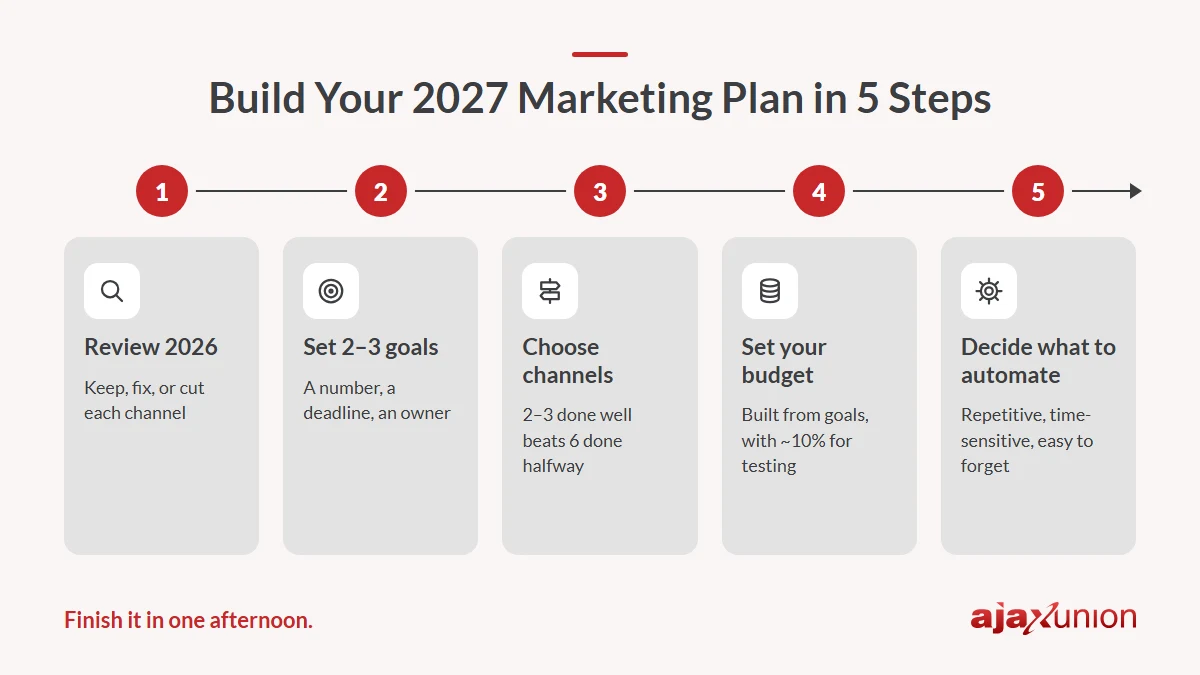
Step 1: Review What Worked (and Didn’t) in 2026
Start with data, not opinions. Gather:
- Leads by source: website forms, phone calls, referrals, ads, social, email
- Which of those sources turned into paying customers
- What each channel cost, in both dollars and team hours
- Any campaign or piece of content that clearly beat the rest
Then sort every channel and tactic into three buckets: keep, fix, or cut.
Example: A business finds its monthly newsletter brought in few new leads but a large share of repeat customers. Meanwhile, a paid social campaign produced lots of form fills that rarely closed. The newsletter goes in “keep.” Paid social goes in “fix”: tighten the targeting and the follow-up before spending more.
If you can’t answer “Where did our customers come from this year?”, that’s a finding too. Better tracking just became a 2027 priority.
Step 2: Set 2–3 Measurable Goals for 2027
More than three goals and nothing gets real focus. Each goal needs a number, a deadline, and an owner.
- Weak: “Get more leads.”
- Strong: “Increase qualified website leads from 40 to 60 per month by June 30, 2027.” (illustrative)
A balanced set usually covers one goal each for acquisition, conversion, and retention. An illustrative example:
- Acquisition: Grow organic website traffic 25% by the end of Q3.
- Conversion: Respond to every new inquiry within 15 minutes during business hours.
- Retention: Get 30% of 2026 customers to buy again or refer someone.
Notice the second goal is about speed, not volume. Often the fastest way to grow revenue is to stop losing the leads you already have.
Step 3: Choose Your Channels
Most small and mid-sized businesses get better results from two or three channels done consistently than from six done halfway. For each channel, ask:
- Where did our best 2026 customers find us?
- Which goal does this channel support?
- Can our team realistically keep it up every week?
Then map channels to goals. Using the example above: organic traffic comes from blog content and SEO; faster response depends on website forms, calls, and text; retention runs through email and review requests.
Leave room for one small test. Give it a fixed window, such as 90 days, and decide upfront what result would earn it a permanent spot.
Step 4: Set Your Budget
Build the budget from your goals, not from last year’s number. A simple process:
- Confirm the total you can spend on marketing in 2027.
- Weight the bulk of it toward proven channels from your Step 1 “keep” list.
- Set aside a small slice, around 10%, for your test channel.
- Count tools and team time, not just ad spend.
One illustrative split: paid search and social 35%, content and SEO 25%, email and automation 15%, marketing tools and platform 15%, testing 10%.
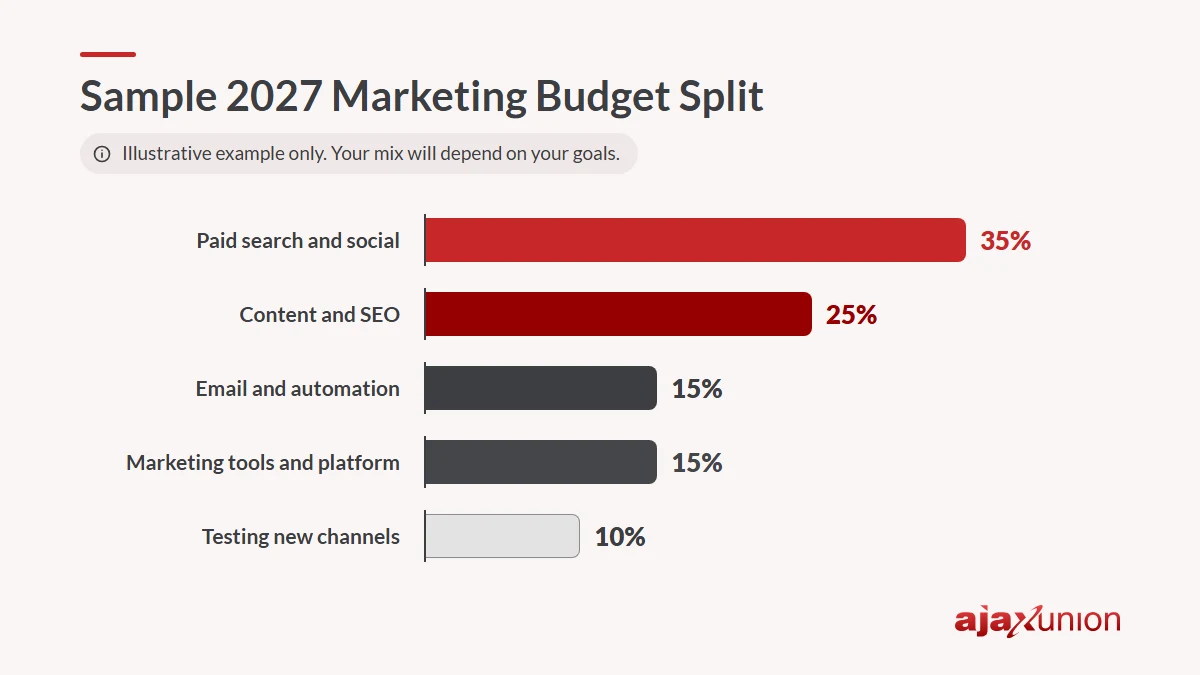
Revisit the split every quarter. Move money toward what’s working instead of waiting until next year’s plan.
Step 5: Decide What to Automate
This is the step most plans skip, and it’s why so many stall. Read back through your plan and flag every task that’s repetitive, time-sensitive, or easy to forget. Common candidates:
- Instant replies to new form submissions and missed calls
- Follow-up sequences for leads who don’t respond the first time
- Appointment confirmations and reminders
- Review requests after a sale or completed project
- Monthly performance reporting
For each task, ask two questions. Does it happen the same way every time? If it slipped for a week, would we lose revenue? Two yeses mean it’s a strong candidate for automation.
Example: “Follow up with every lead within 24 hours” depends on someone remembering. An automated sequence sends that first message at 9 p.m. on a Friday, when nobody’s at their desk.
Turn the Plan into a One-Page Calendar
A plan without dates is a wish list. Put everything on one page with three layers:
- Quarterly priorities: one or two major focuses per quarter, not ten.
- Monthly check-ins: 30 minutes on the same day each month to compare results with your goals.
- Owners: one name next to each priority, even if several people help.
An illustrative 2027 roadmap might look like this:
- Q1: Set up tracking and automated lead follow-up. Launch your content cadence.
- Q2: Start your test channel. Add automated review requests.
- Q3: Evaluate the test, then scale what’s working. Run a customer retention campaign.
- Q4: Review the year’s results and draft the 2028 plan.
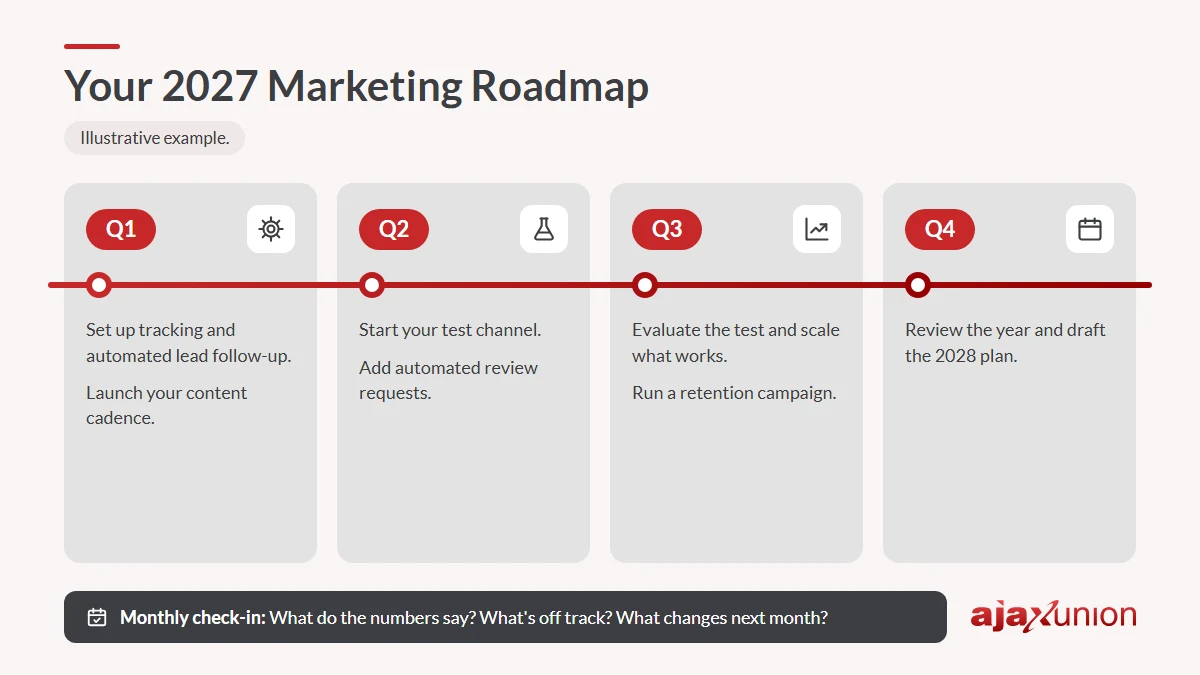
Keep the monthly check-in short. Three questions are enough: What do the numbers say? What’s off track? What changes next month?
Make the Plan Run Itself with Automation
By March, many marketing plans are already slipping. Usually the strategy wasn’t wrong. The execution depended on people who already had full plates. These are the pieces that tend to fall apart first:
- Lead follow-up. Inquiries sit for a day or two. By the time someone calls back, the prospect has already hired someone else.
- Reporting. The monthly report becomes quarterly, and then it stops.
- Email nurturing. The newsletter gets skipped whenever the team is busy, which is exactly when steady contact matters.
- Reminders and recurring tasks. Review requests, renewal notices, and check-ins fall through the cracks.
Automation turns each of these from a to-do item into a system. You set it up once with three parts: a trigger (a new lead, a booked appointment, a completed sale), an action (a text, an email, a task for your team), and a schedule. After that, it runs whether or not anyone remembers.
That frees your team for real conversations and strategy.
Start small. Automate the one task tied to your most important goal, confirm it works, then add the next.
Writing the plan is the easy part. Running it every week is where most businesses fall short. That’s what Ajax Union MarTech is built for. It brings lead capture, follow-up, email and text nurturing, appointment reminders, review requests, and reporting into one connected platform. The automation you choose in Step 5 actually happens. Our team sets it up with you, based on your goals and your data, so your 2027 marketing plan runs on its own instead of waiting for someone to remember.
If you’re mapping out 2027 now, explore Ajax Union MarTech to see what your plan could look like in action. Prefer to talk it through first? Contact the Ajax Union team, and we’ll help you figure out where to start.
Thanks for reading!